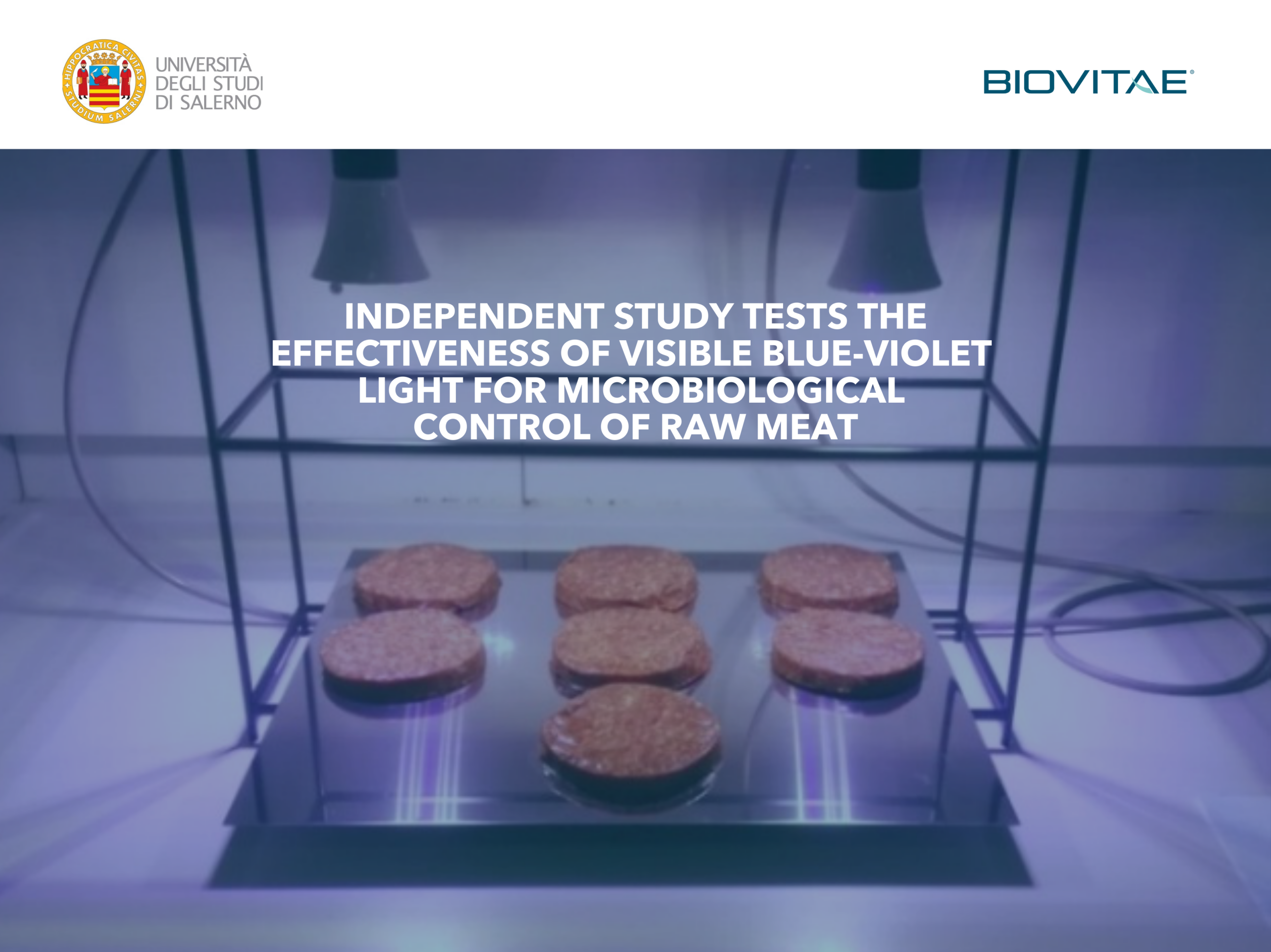
A new preprint study conducted by the University of Salerno tested the effectiveness of visible blue-violet light (400-420 nm, UV-free) on beef hamburgers during normal handling operations, simulating real conditions in professional kitchens and food processing facilities.
The most critical phase: after opening
The study focused on the most delicate moment: after package opening, when products are exposed to repeated handling, contact with work surfaces, and environmental contamination.
The results: fewer bacteria with blue-violet light
Samples exposed to blue–violet light were compared with samples under standard lighting, both at room temperature and under refrigeration.
The results showed consistently lower bacterial counts in illuminated samples, with:
- slower bacterial growth at room temperature
- greater microbiological stability under refrigeration
- continuous control action, not a shock treatment
The observed effect works as a constant environmental safeguard, integrable into normal operations without interrupting workflow.
Effects on the product
In terms of quality, the study detected gradual and manageable changes:
- moderate moisture loss
- slight increase in firmness
- minor color variations
All these effects depend primarily on temperature and exposure time, and are significantly reduced when working under refrigeration.
Conclusions
The data confirm that visible blue–violet light can function as a continuous sanitization tool, safe for operators and usable during normal activities, without the constraints typical of UV-C lamps.
The complete study document is available for download.
Source: Barba A.A., Lamberti G., “Improving the Microbiological Safety of Raw Meat Through Visible Blue–Violet Light Irradiation”, University of Salerno, open access preprint under CC BY 4.0 license, DOI: 10.20944/preprints202601.1932.v1